- Home
- Solutions
- RTI displays
- E-paper displays
E-ink passenger information
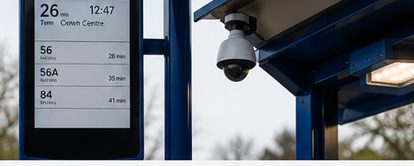
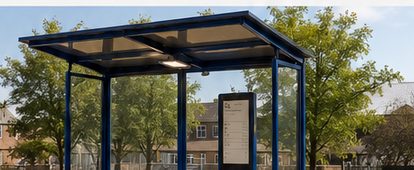
E-paper bus stop displays
Low-power, sunlight-readable real-time displays that run on solar or battery power, so live departures can go wherever passengers wait.
RTI Displays
Clear, reliable information at every stop.
3iS Transport supplies, installs and maintains real-time passenger information displays for bus stops, shelters, transport interchanges and mobility hubs. Our range includes low-power e-paper displays and full-colour TFT/LCD screens, helping passengers access arrival times, timetables and service updates with confidence. We work with local authorities to specify the right display technology, mounting arrangement and power solution for each location, including battery and solar-powered options where suitable. From initial specification through to installation, commissioning and ongoing maintenance, we support the delivery of clear, reliable passenger information across urban and rural networks.
Features
Why e-paper works at the bus stop.
Readable in bright sunlight
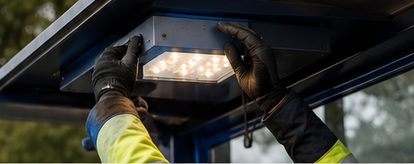
E-paper reflects light like printed paper, so the brighter the day, the clearer the screen. Built-in LED edge lighting takes over after dark.
Ultra-low power
The screen only draws power when its content changes, which is what makes solar and battery operation practical at a bus stop.
Off-grid by design
With solar power and wireless connectivity as standard, a display can be installed in hours, without digging up the footway to lay cables.
Live data, open standards
Real-time arrivals from your bus data through GTFS, GTFS-RT and SIRI, with API and MQTT integration for other systems.
Accessible information
Optional text-to-speech, an integrated or external push button, and Braille button identification.
Built for the street
Extruded aluminium enclosure with toughened, laminated anti-vandal and anti-scratch glass, rated to at least IP65 and IK08.
Tamper alerts
An integrated accelerometer detects aggressive movement and raises an alarm by email or on the management dashboard.
Greyscale or colour
High-resolution greyscale screens as standard, with colour options available on selected sizes.
Power options
Power where there is none.
Because e-paper uses so little energy, the display can be powered in whatever way suits the location.
Solar
A solar module charges a small internal battery, so the display runs around the clock. Modules come in 20W and 40W sizes to suit the site's sunlight.
Long-life battery
Where solar or mains power isn't feasible, an integrated long-life battery gives five or more years of operation.
Mains
Hard-wired into the mains where a supply is already available at the stop.
Street light power
Charges the display from a street lighting circuit while the lights are on.
Power over Ethernet
Power and data together through a single Ethernet cable, ideal inside stations and interchanges.
The range
Sizes and formats.
- Resolution
- 1600 × 1200 px
- Dimensions
- 469 × 269 × 65 mm
- Weight
- 7 kg
Single, double and triple screen versions, plus a compact model.
- Resolution
- 1600 × 1200 px
- Power
- Battery or solar
A replacement for legacy LED flag displays where there is no shelter.
- Format
- Open frame
- Mounting
- Standard or custom brackets
Built into a shelter or totem structure.
- Resolution
- 2560 × 1440 px
- Dimensions
- 772 × 470 × 58 mm
- Weight
- 25 kg
VESA 200 mounting. Greyscale, with colour available on this size.
- Format
- Open frame, large format
- Mounting
- Standard or custom brackets
For busy interchanges and mobility hubs.
Mounting
- Pole mountSecure brackets for timetable poles from 76 to 152 mm diameter.
- Flag mountReplaces an LED flag display at on-street stops without a shelter.
- Bus shelterOpen frame displays built into any shelter design with standard or custom brackets.
- TotemOpen frame displays built into a freestanding totem.
How it works
How live data reaches the stop.
Your bus data
Live arrivals from AVL systems in GTFS-RT or SIRI, timetables in GTFS.
Cloud platform
Content is laid out, scheduled and monitored online, from any internet-connected device.
Cellular link
Each display connects over the mobile network as standard, or Wi-Fi or Ethernet.
At the stop
The screen updates only when something changes, so it stays readable and sips power.
Management
One cloud platform for the whole network.
Every display is managed online: what it shows, when it shows it, and how it is performing.
- Split-screen layouts, content rotation and interactive toggling
- Publish now or on a schedule: weekends, public holidays or rush hour
- Change one display, a whole route or the entire network at once
- See exactly what any display is showing now, or showed at a set time
- Monitor battery, solar charging, signal strength, temperature and humidity
- Add travel extras: service changes, maps, local events, news and weather
FAQ
E-paper display questions
How are e-paper displays powered?
Solar power is standard: a solar panel charges a small internal battery so the display runs around the clock, and it can keep going for at least two weeks without sunshine. Where solar isn't suitable, a long-life battery gives five or more years of operation, or the display can use mains, street light power or Power over Ethernet.
Can passengers read the screen in direct sunlight and at night?
Yes. E-paper reflects light like paper, so it is easiest to read in bright sun. After dark, low-power LED edge lighting built into the enclosure lights the screen.
Where does the information come from?
Each display connects to a cloud management platform over the mobile network, or Wi-Fi. The platform takes real-time data in open standards such as GTFS, GTFS-RT and SIRI, and APIs can be created for other formats.
How long does installation take?
With solar power and wireless connectivity, a display can be installed off-grid within hours, on a pole, wall, shelter or totem.
How are the displays protected against vandalism?
The enclosure is extruded aluminium with toughened, laminated anti-vandal glass and a secure fixing, rated to at least IP65 and IK08. An accelerometer raises an alert if a display is tampered with.
Are colour screens available?
Greyscale is standard. Colour options are available on selected sizes; ask us which suit your stops.
Get in touch
Discuss your stops
If you are a local authority, transport organisation, or public-sector partner looking to deliver or maintain passenger transport infrastructure, our team would be pleased to discuss your requirements.